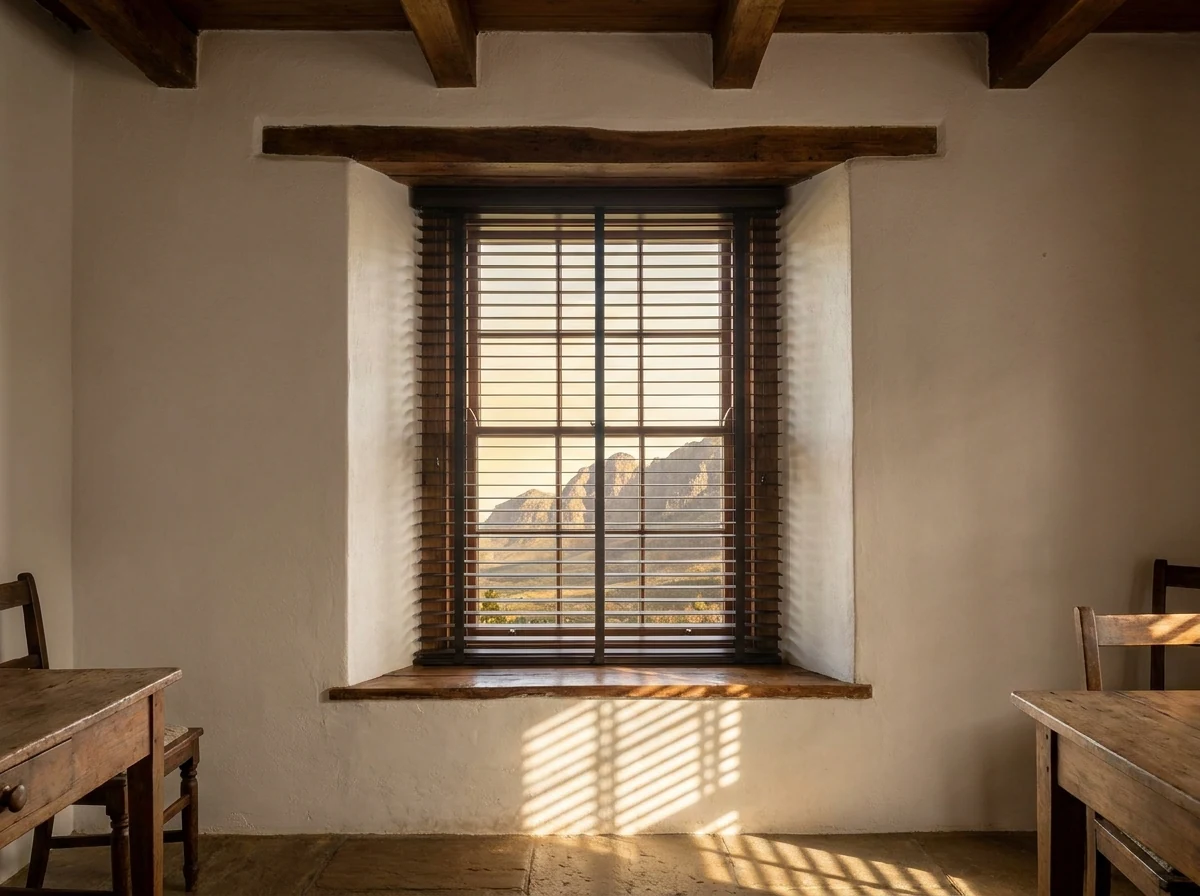
Grapes are grown here for one reason above all others: the Cape Winelands gives a vine a hot day and a cold night, over and over, all summer. That swing makes the wine. It also makes the houses awkward. A room between Stellenbosch and Wellington has to solve two opposite problems inside the same twenty-four hours — and most window specifications only ever solve one of them. This guide is about solving both, and it costs you nothing.
The Cape Winelands district runs inland from the Hottentots Holland and Simonsberg ranges across the Stellenbosch, Drakenstein, Witzenberg, Breede Valley and Langeberg valleys.1 On a map it looks coastal. In practice, the mountains between here and the sea do most of the work of a much longer distance: the cool marine air that keeps the Peninsula mild in February is largely spent by the time it has climbed the first range, and what reaches the vineyards behind it is drier and warmer.
Add the region's Mediterranean-type climate — wet, cool winters and hot, dry summers, with the rain concentrated between roughly May and August2 — and you get the condition that defines every window here. Dry summer air holds very little water vapour, and water vapour is what keeps a night warm. So the ground sheds its heat straight back to a clear sky after sunset, the valley floor cools right off by first light, and then the same clear sky lets an almost vertical sun start rebuilding that heat by nine in the morning.
You are not shading a hot house. You are shading a house that is cold at half past six and hot at half past four, every day of a Winelands summer.
Everything that follows is downstream of that. It is also why a specification lifted straight off a coastal suburb — heavy blockout everywhere, nothing outside, nothing insulating — disappoints in this region within one season.
Two
The arithmetic that holds from Stellenbosch to Wellington
The four wine towns sit remarkably close together in latitude — Wellington near 33.64°S, Paarl near 33.73°S, Franschhoek and Stellenbosch near 33.9°S.3 That is a spread of about thirty kilometres north to south, which means one set of sun numbers is good enough for the whole basin. Working it from the latitude and the earth's 23.44° tilt4, and stating plainly that this is our arithmetic rather than a survey:
Midsummer noon: the sun stands about 79–80° above the horizon. Nearly straight down. A generous eave or a deep reveal shades a north window almost completely at that hour, and north glass is genuinely easy in December.
Midwinter noon: about 32–33°. The same eave shades nothing. Low winter sun drives deep into north-facing rooms — which is welcome here, and worth not blocking permanently.
Where the sun sets: in midsummer roughly 241°, which is south of due west; in midwinter roughly 299°, north of it. The late beam therefore lands on west and south-west glass in summer — the exact hours a terrace is in use.
The practical reading: north is a seasonal problem, west is a daily one. North wants shading you can reverse when the season turns. West wants shading that intercepts a low, direct beam coming in almost horizontally, which no eave on any Winelands house has ever managed.
Three
The cold end: keeping warmth on the room's side
Most people call us about heat. The cold half of the swing is the half that quietly costs more, because it runs from about April to September and it runs all night.
The mechanism is unexciting. Glass is the thinnest, least insulating part of any wall. On a still, clear Winelands night the outside face of that pane is radiating heat to a black sky, so its inside face sits well below room temperature, and the air touching it cools, drops to the floor and pulls more warm air across to be cooled in turn. A single large pane can empty the warmth out of a room by two in the morning with no draught at all.
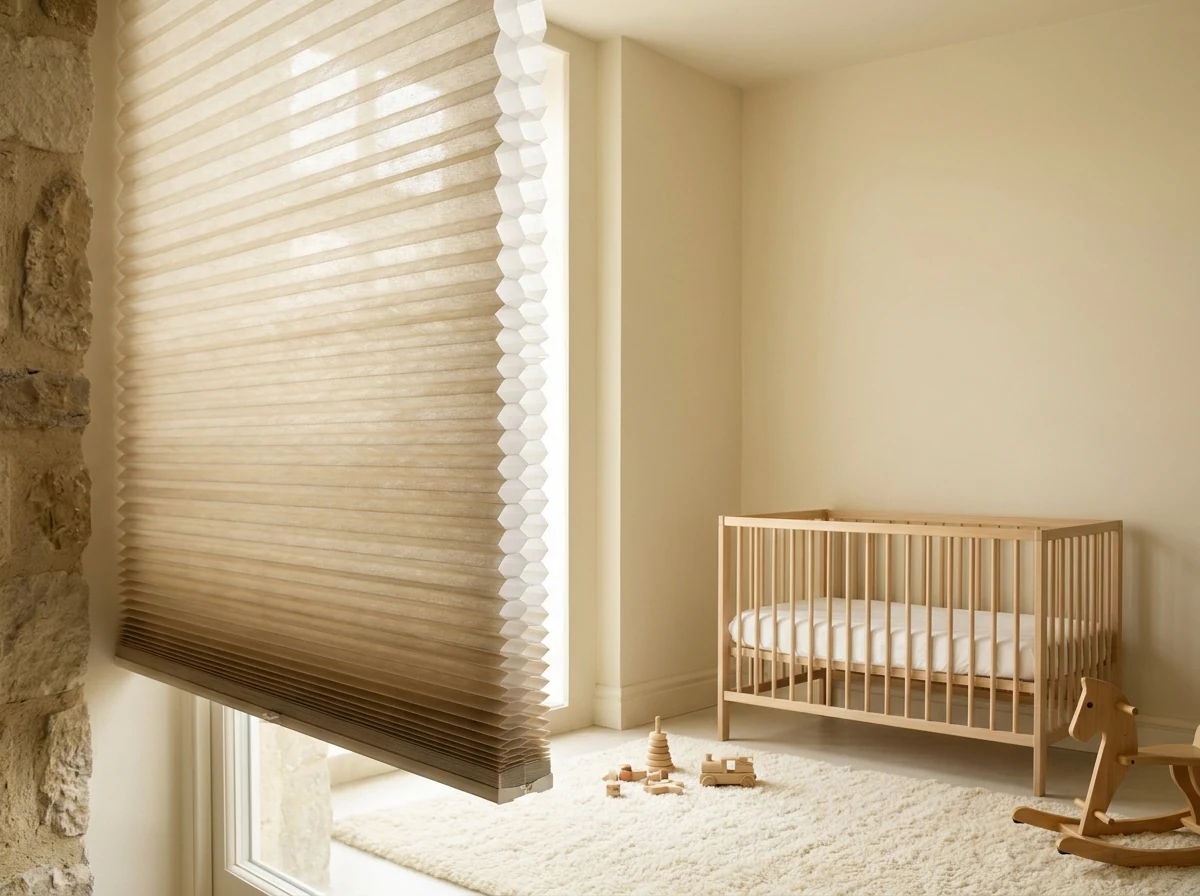
A cellular honeycomb blind is the one product that directly answers this. It is built from a concertina of hexagonal cells, each holding a pocket of still air; closed inside the reveal at night, that trapped air sits between the room and the cold glass and slows the exchange right down. The fabric is only the container — the still air is the product.
Where we'd put them first
Bedrooms and nurseries, then any room with a big single-glazed opening that people sit in after dark. In a guest cottage where the heating is a fireplace and good intentions, cellular blinds change the room more than any other thing we fit.
A double-cell fabric holds more air than a single. Where a room needs privacy at eye level but daylight above, the same blind can be made to open from the top down and close from the bottom up.
Being straight with you: a cellular blind does not tilt, so it manages light and heat but never view, and it does not enjoy being scrubbed. It also cannot fix a wall that is genuinely damp or a window that no longer closes — those are building repairs and we will say so rather than sell fabric over them.
The cells are the whole point — a pocket of still air held between a cold pane and a room somebody has to sleep in.Four
The hot end: intercept it outside or not at all
Now the other end of the same day. By mid-afternoon in January the valley floor has been absorbing near-vertical sun for six hours, the air is dry, and a west-facing glass wall is about to take a low beam straight in the face for two more.
Here the physics is blunt and it decides the product. Sunlight that has already passed through the glass is inside. An internal blind can absorb it, but it then becomes a warm object in your room and radiates that heat back at you. It controls glare well and heat only partially. Stop the same energy on the outside of the pane and the glass never warms in the first place — which is why the external range is our premium tier, and the honest answer for a hot Winelands elevation.
The external three, and what each is for
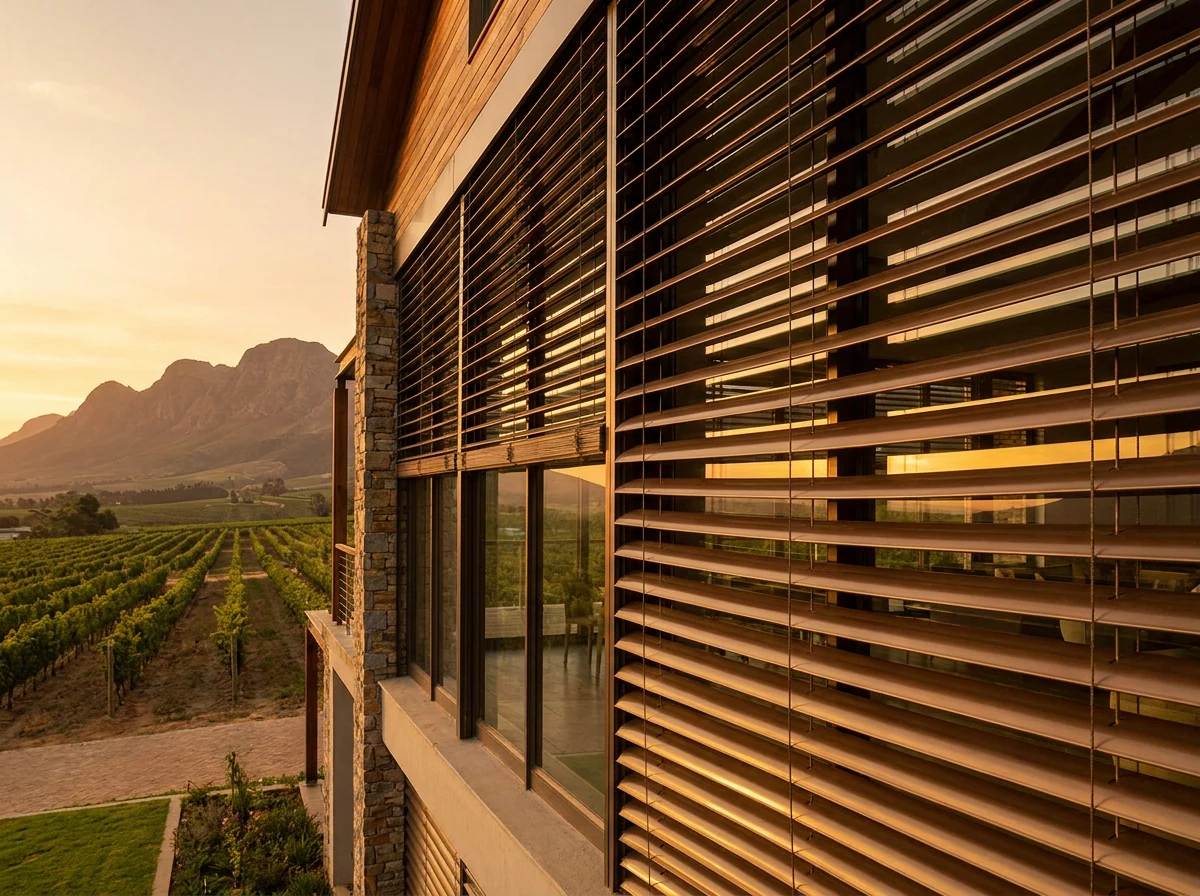
External venetian blinds — aluminium slats carried outside the glass that raise and tilt. Tilt is what earns them their price here: you can cut the beam and keep the vineyard, and in winter you raise them completely so the low sun you actually want comes through. On a north elevation that is the whole seasonal problem solved with one motor.
Roller shutters — rigid slats that roll down outside the pane for shade, darkness and a useful measure of quiet. In this region they earn their keep twice: shade in February, and an insulating air gap against the glass on a July night. To be clear, these are shading shutters — heat, glare and blackout. Security-rated shutters are a different product entirely and we quote them separately, on request.
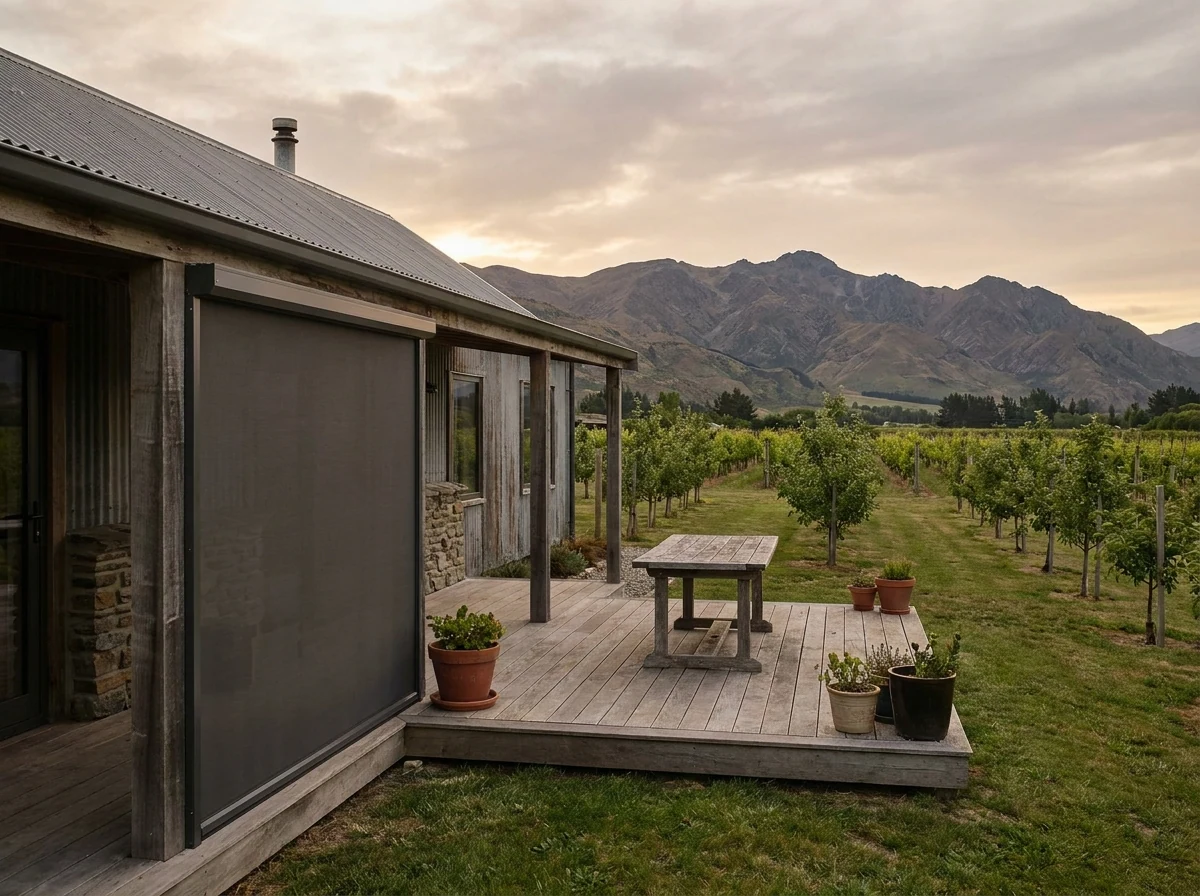
Zip screens — mesh running under tension in side channels down a terrace or veranda opening. Because the fabric is held on both edges it does not flap or lift, so it stays usable in wind that would fold an awning away, and it keeps the view while dropping the glare.
The trade-off: all three fix to the outside of the building. That costs more than an internal blind, it changes how the facade reads, and on most estates it needs approval before anything is ordered. Where an external fixing genuinely is not possible, a light-coloured sunscreen mesh inside the glass is the honest second best — cheaper, and clearly weaker on heat.
Slats working on the outside of the glass on a west face — down for the four hard months, raised right out of the way for the eight that want the sun.Five
The wind changes character twice a year
Anything you hang outside has to survive two completely different winds, and they arrive in different seasons from different directions.
Summer: the south-easter, weakening as you go inland
The south-easterly that dominates a Cape summer — blowing most persistently through the warm months and strongest in the afternoon5 — still reaches Stellenbosch with real force off False Bay. It fades progressively further inland, so Paarl and Wellington feel far less of it and inherit continental heat instead. Franschhoek makes its own weather regardless: cool air spills down off the ranges enclosing the valley on most summer evenings.
Autumn and winter: the berg wind
The berg wind is the opposite animal. Air descends from the interior plateau toward the coast, compresses and warms as it drops, and arrives hot, dry and gusty — and it occurs mainly in the cooler months.6 It is what produces those bewildering 30°C days in the middle of winter, and it is hard on outdoor fabric because nobody expects it.
The conclusion is the same for both: anything soft that lives outside must retract, and it should not wait for a human to decide. Folding-arm awnings, zip screens and external venetians on our spec sheet are motorised with a wind sensor as standard, so the system takes itself in before a gust arrives rather than after the damage is done. An awning that is left permanently extended through a Winelands autumn is an awning you will be replacing.
Held on both edges in channels, a zip screen stays flat and usable in the sort of gust that folds an awning — the reason it wins on an exposed farm terrace.Six
Dust, harvest and what actually survives here
This is farmland with houses on it, and that changes what wears out. Three cautions we would give anyone dressing windows anywhere in the basin:
Assume dust between November and April
Dry months, gravel farm roads, tractors and harvest traffic put a fine film on everything facing the werf or the road. Pale, smooth, wipeable finishes stay looking right far longer than deep textures and heavy weaves, which hold the dust in the pile. This is not a reason to avoid fabric — it is a reason to choose it with a cloth in mind.
Timber belongs in dry rooms only
Timber venetian slats look exactly right in an old Cape window and are the wrong material for a scullery, a bathroom or a window above a busy sink. Moisture works into the slat, the slat takes a set, and it never comes back. Aluminium in those rooms, every time — it wipes down and does not care.
Outdoor shade must close as well as open
A folding-arm awning that winds fully into a closed cassette keeps its fabric dry through the wet months and out of the berg wind in between. Retractability is not an upgrade in this region; it is the difference between a ten-year awning and a three-year one.
Seven
Four towns, four small corrections
The swing, the sun angles and the wind seasons apply everywhere in the basin. What changes from town to town is small but real, and it is usually the thing that decides between two otherwise equal products.
Stellenbosch
Closest to False Bay, so it keeps more of the summer south-easter than anywhere else on this list — wind sensors matter most here. The old town core is heavily oak-shaded in summer and bare in winter, which flips a street-facing room's light completely between seasons, and the historic centre carries genuine heritage constraints on anything that shows from the pavement.
Franschhoek
A valley closed by mountains on three sides. The practical effect is that your effective sunset is much earlier than the almanac's — the ridge takes the sun long before the horizon does — so afternoon glare is short and sharp rather than long. Evening downdraught off the slopes is the routine wind, and it is cool rather than hot.
Paarl
Open to the north and built around a granite dome that holds and re-radiates heat late into the evening. Homes on the mountain side get a second, indirect helping of afternoon warmth off the rock and the light-coloured stone around it, which is a heat problem more than a glare one — and heat problems are external-shading problems.
Wellington
Furthest inland of the four, at the foot of the road up Bain's Kloof. Least coastal relief, most continental heat, and a strong working-farm character — more werf, more gravel, more terrace used for actual work. Durability and wipeability outrank delicacy here more than anywhere else in the region.
A Stellenbosch street window in summer leaf. The same window in July, with the oaks bare, is a different room — which is an argument for a mesh you can see through rather than a fabric you cannot.Eight
Old openings, and the sixty-year line
A great many Winelands buildings are well over sixty years old, and that is a legal fact before it is an aesthetic one. Under the National Heritage Resources Act, no structure — or any part of a structure — older than sixty years may be altered or demolished without a permit from the provincial heritage resources authority, which in the Western Cape is Heritage Western Cape.7 Several town centres in the region carry additional protection through their municipal planning schemes on top of that.
The line is easy to hold in your head:
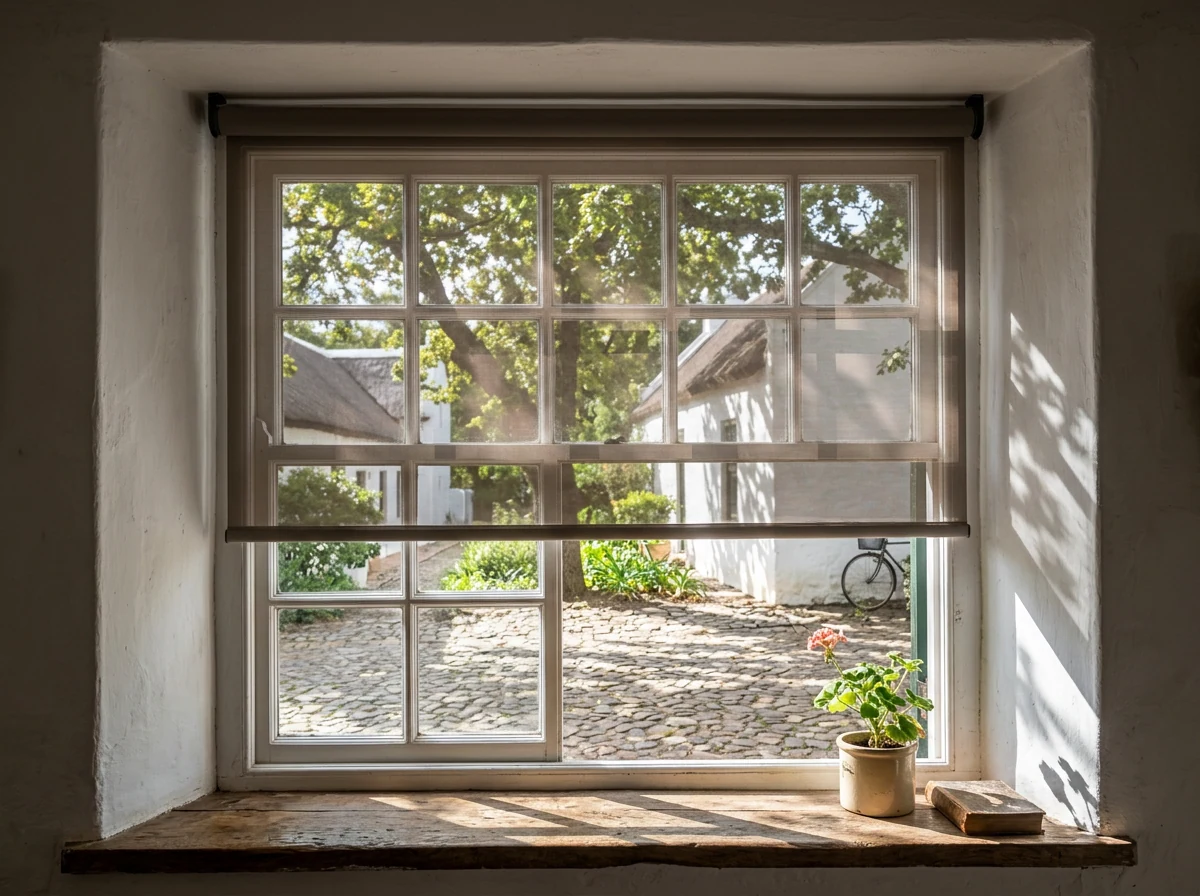
Inside the reveal is furnishing. A blind fitted within the window opening touches nothing structural and asks nobody's permission.
Outside the wall is an alteration. A headbox, a guide channel, an awning cassette or a screen track bolted to a facade changes part of the structure. On an older building that needs asking about first.
Old Cape openings also want a particular kind of restraint. Small panes divided by fine glazing bars, set deep in a thick wall, are the whole character of the window — a bulky headbox mounted over the outside of that opening simply erases it. Inside the reveal, a slim roller or a timber-slatted venetian sits within the depth the wall already gives you and leaves the elevation exactly as it reads from the street.
We help by keeping profiles slim, colours quiet and paperwork complete: drawings, product data and a written specification you can hand across. What we will not do is pretend a permit is a rubber stamp, or lodge anything with an authority on your behalf.
Fitted within the depth of the wall rather than over it — the reveal keeps its shadow, and the elevation is unchanged from the street.Nine
The five things a phone call cannot settle
Everything above comes off a map, a calendar and some arithmetic. These five come off your floor:
Which rooms actually run cold. The households who live with the swing know exactly which two rooms are unbearable at seven in the morning. That knowledge decides where cellular blinds go and where a plain roller will do.
What the wall is made of behind the plaster. Solid stone, old brick, a cavity or later framing — it determines the fixing, and whether anything external can hang there at all.
How square and how deep each reveal is. Old openings move. We measure at three heights, because a centimetre decides between fitting inside the reveal and fitting over it.
How much sky each window really sees. Between mountains, gables, a werf wall and a mature oak, two windows on one elevation can live in different climates. That is worth walking, not estimating.
Power and permission. Whether a motor has a socket within reach, whether a battery tube can be recharged without a ladder, and who signs off on anything visible from outside.
That is the honest reason the measure is free and unhurried. Every one of those is far cheaper to discover before a quote than after a fitting.
Ready when you are
Have someone read your rooms at both ends of the day.
A free in-home measure, anywhere in the Cape Winelands — then a written quote, per opening, with the trade-offs said out loud.
Cold mornings, hot afternoons, wind on the terrace or glare off the granite — say which, and one of our expert consultants will contact you shortly to arrange a free in-home measure. No obligation, no call-centre queue.
POPIA notice: the details you submit are used only to arrange your free in-home measure and quote, and are never shared or sold to a third party.
Sources
Everything above, traced back
Every geographic and climatic claim on this page traces to one of the references below. The sun-angle and sunset-bearing figures in section two are our own arithmetic from published latitudes and the earth's axial tilt, and are described as such. The product recommendations throughout are our professional opinion, not a finding.
Wikipedia — Cape Winelands District Municipality (the district's extent and its constituent municipalities, including Stellenbosch, Drakenstein, Witzenberg, Breede Valley and Langeberg).
Wikipedia — Stellenbosch (Mediterranean-type climate with hot dry summers and cool wet winters; monthly climate table showing rainfall concentrated in the winter months).
Wikipedia — Paarl, Franschhoek and Wellington (published coordinates for each town, and Paarl's granite dome; the latitudes used in our arithmetic).
Wikipedia — Axial tilt (the earth's obliquity of about 23.44°, the second input to the noon-altitude and sunset-bearing arithmetic in section two).
Wikipedia — Cape Doctor (the persistent south-easterly of the Cape summer months, its seasonality and its behaviour around the mountains).
Wikipedia — Berg wind (hot, dry katabatic wind descending from the interior plateau toward the South African coast, warming as it compresses, occurring mainly in the cooler months).
SAFLII — National Heritage Resources Act 25 of 1999, section 34 (no structure, or part of a structure, older than sixty years may be altered or demolished without a permit from the provincial heritage resources authority).
South African Weather Service — weathersa.co.za (official South African climate and forecast data; the place to check your own town's monthly maxima, minima and rainfall rather than take ours on trust).
Nothing on this page is a heritage-approval opinion, an estate architectural ruling or an energy assessment. Those belong to Heritage Western Cape, your local authority, your estate's architectural committee and a suitably qualified professional. What you have read here is offered free, in general terms, and with nothing attached to it.
Download a copy to share with whoever else has a say in the windows.